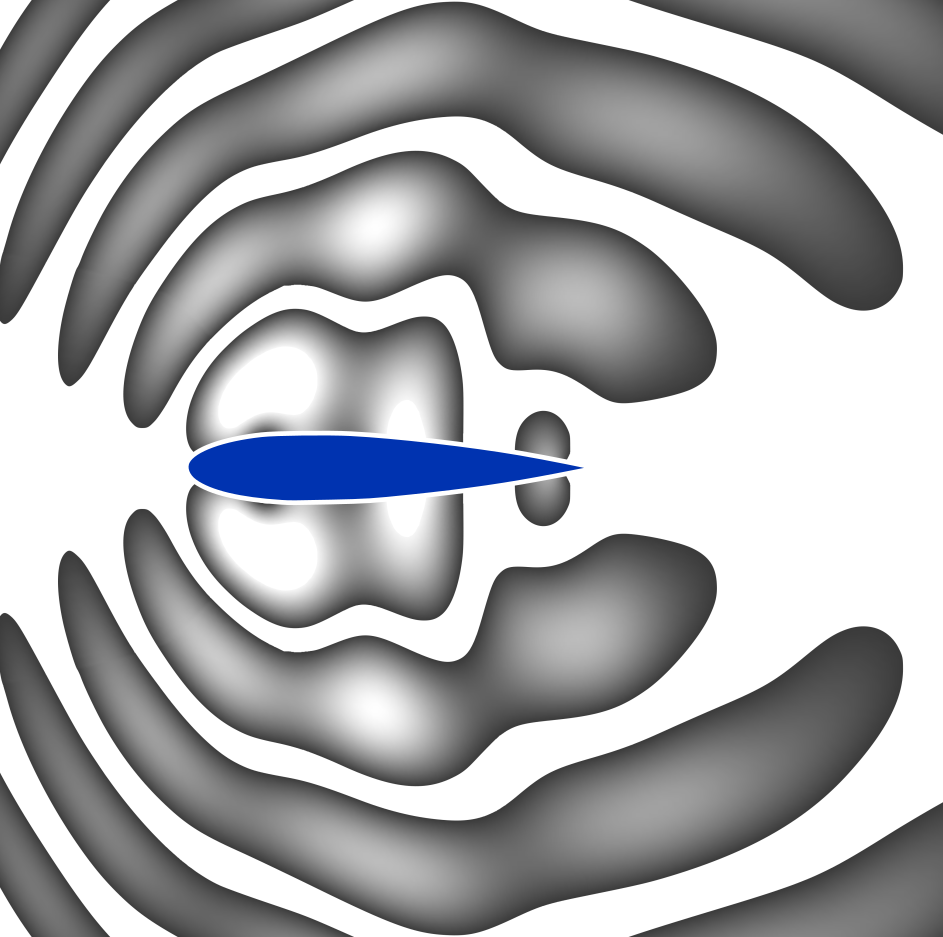

An experimental study of rotor aeroacoustics with aeroelastic effects under edgewise flight conditions
Summary
Rotor blades in eVTOL aircraft are often assumed rigid in noise studies, but their thin, slender design makes them prone to large aeroelastic deformations during edgewise forward flight. Measurements in an anechoic wind tunnel showed that a thin-root variant (lower flapwise stiffness) of a 229 mm baseline rotor experiences significantly greater time-varying deformations, resulting in a reduced broadband noise compared to the baseline. Wavelet-based beamforming confirmed the advancing blade as the dominant noise source, with the broadband reduction linked to weakened blade-vortex interactions, improving understanding of how blade flexibility affects eVTOL rotor acoustics.
Rotors are the primary noise contributors in eVTOL aircraft. Investigations into rotor noise problems often assume that rotor blades are rigid, neglecting their aeroelastic effects. However, rotor blades are typically designed to be thin and slender for improved aerodynamic efficiency. This makes them highly susceptible to aeroelastic deformations, especially during edgewise forward flight.
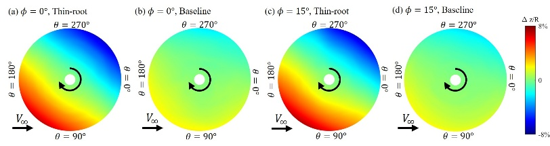
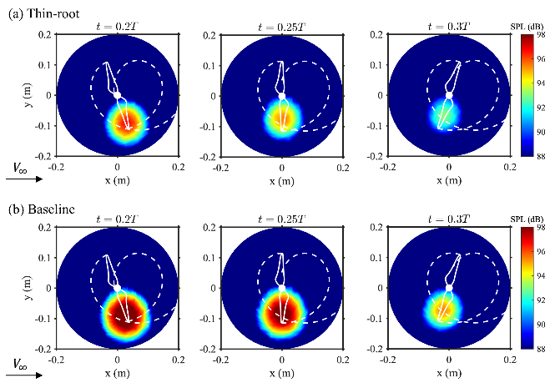
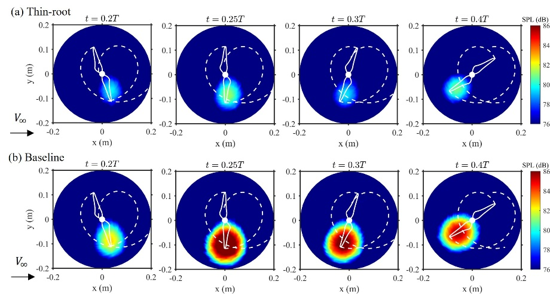
In this work, we investigate the aerodynamic and aeroacoustic performance of a baseline rotor with a diameter of 229 mm and its thin-root variant, which has significantly lower flapwise stiffness. The measurements were conducted in an anechoic wind tunnel under edgewise forward flight conditions. First, deformation measurements reveal that the thin-root rotor experiences significantly larger time varying deformations. Then, acoustic measurements indicate that the thin-root rotor produces a higher blade-passing frequency (BPF) tone and a lower broadband noise level compared with the baseline. Next, results from a wavelet-based beamforming method show that the advancing blade is the primary noise source, with the reduction in broadband noise attributed to weakened blade-vortex interaction (BVI). These findings enhance our understanding of the impact of rotor blade deformation on eVTOL rotor acoustics.
Reference
Peng, Z., Chen, W., Chen, B., Zhou, P., and Zhang, X., “An Experimental Study of Rotor Aeroacoustics with Aeroelastic Effects under Edgewise Flight Conditions,” presented at the 54th International Congress and Exposition on Noise Control Engineering., 2025.