
Computational Aerodynamics of Cyclists
Summary
This research combines numerical simulation with controlled wind-tunnel measurements to investigate cycling aerodynamics. The computational work resolves flow structures around cyclist-bicycle configurations and examines how posture, crosswinds, wheel design and cyclist spacing affect aerodynamic forces and wake behaviour. The results support the interpretation of experiments and the aerodynamic assessment of cycling equipment and race configurations.
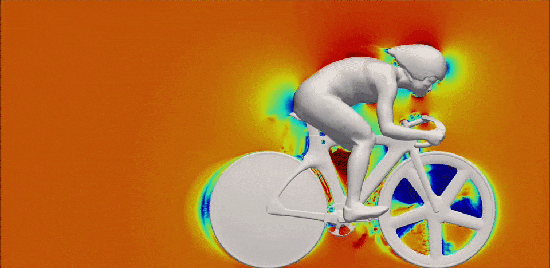
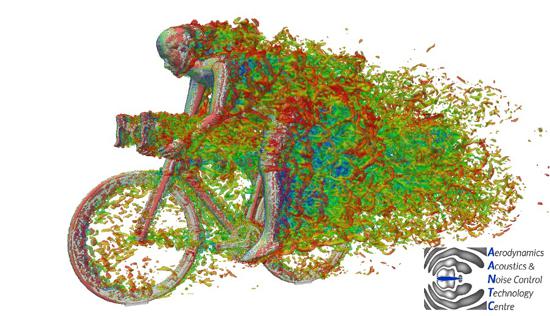
AANTC uses computational fluid dynamics to study airflow around cyclists, bicycles and cycling equipment. Numerical flow fields reveal wake development and aerodynamic interactions associated with riding posture, leg position, wheel configuration and the relative position of cyclists.
Computational models provide three-dimensional descriptions of the flow around cyclist-bicycle systems. The simulations identify flow separation, vortical structures and wake development around the rider and bicycle, giving physical context to measured forces. Related studies address complete cyclist geometries, individual wheel configurations and aerodynamic interactions between cyclists.
Wind-tunnel measurements provide an experimental reference for selected numerical studies. Published work compares computed and measured aerodynamic forces, and uses wake measurements to examine the corresponding flow structures. Particle Image Velocimetry provides an additional comparison for studies of cycling-wheel wakes. Together, these methods connect computed flow fields with measurable aerodynamic behaviour and support the careful assessment of posture, equipment and race configurations.