
The Aeroacoustic Characteristics of a Heaving Airfoil
Summary
Airfoil oscillation is a widely observed phenomenon in real applications,
such as natural flyers, helicopter and drone blades, etc. This work studies
the aeroacoustic characteristics of a heaving airfoil by experimental
methods
Airfoil oscillation is a widely observed phenomenon in real applications, such as natural flyers, helicopter and drone blades, etc. The instantaneous flow pattern on a pitching airfoil is acquired by a high-speed PIV system.
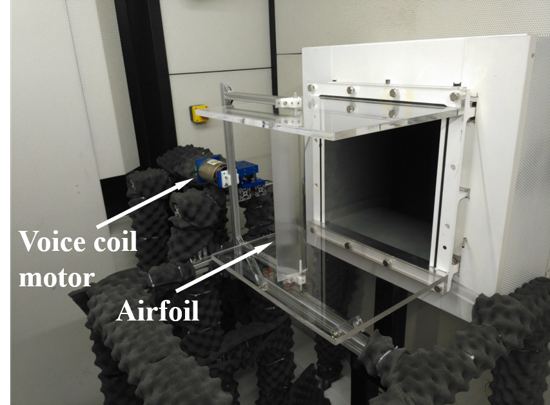
All measurements were conducted in the low-speed open-jet facility in the
Hong Kong University of Science and Technology. The tunnel outlet has a
dimension of 0.4m × 0.4m, and the largest wind speed of 70m/s.
A straight wing model with the profile NACA 0012 was tested, and it had a
100mm chord and 399mm span. The heaving motion was actuated by a
voice coil motor. The far-field noise was measured by three microphones
placed along an arc centered at the trailing edge of the airfoil
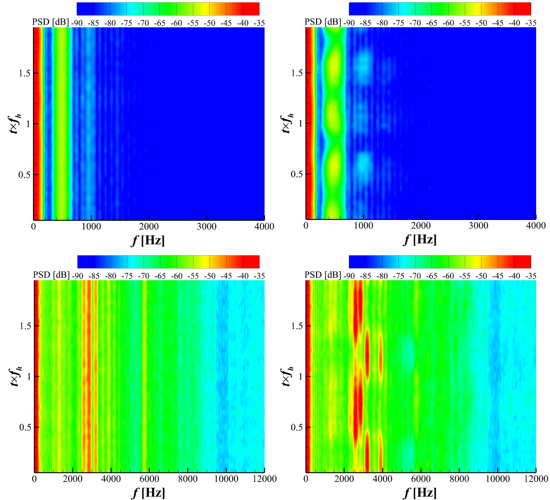
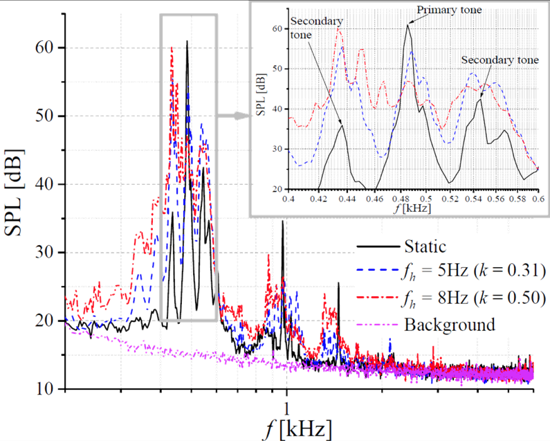
A comparison of the noise spectra between the stationary and heaving cases
at flow speeds of 10m/s and 40m/s are given in the figures below,
respectively. The following observations can be obtained:
1. The heaving motion suppresses the height of the primary tone and
enhances the secondary peaks
2. When the flow speed is 10m/s, a broadband hump in the vicinity to the
primary tone raises due to the heaving motion.